
2539a
MATRIX-MFO Tandem Workshop: Machine Learning and AI for Mathematics
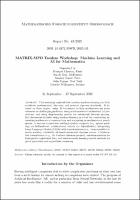
 Report (245.3Kb)
Workshop
2539aPeriod
21 Sep - 26 Sep 2025Abstract
This workshop explored how modern machine learning can both accelerate mathematical discovery and preserve rigorous standards. It focused on three angles: using AI techniques to help mathematicians make advances on challenging problems; using mathematics to understand AI predictions; and using deep-learning models for automated theorem proving.
Key discussions included using machine learning as a tool for constructing interesting mathematical constructions and navigating in mathematical search spaces, to uncover conjectures and high-quality examples (e.g., sphere packings via DiffuseBoost, combinatorial objects via AlphaEvolve); Integrating Large Language Models (LLMs) with formal systems (e.g., Lean/mathlib) to create scalable, certifiable AI-based automated theorem prover; Collaborative formalization (e.g., the Carleson theorem project), autoformalization for high-quality supervised data, and reinforcement learning/search methods for proof generation and algorithmic reasoning.
Report
Workshop Report 2025,43Organizers
François Charton, Paris; Jan de Gier, Melbourne; Amaury Hayat, Paris; Julia Kempe, New York; Geordie Williamson, SydneyOberwolfach Photo Collection
Open Workshop PhotosThe following license files are associated with this item:
http://creativecommons.org/licenses/by-sa/4.0/Unless otherwise noted, the content of this report is licensed under Creative Commons Attribution-ShareAlike 4.0 International.
 Open Preview
Except where otherwise noted, this item's license is described as http://creativecommons.org/licenses/by-sa/4.0/